


Título – Decision-Focused Learning Enhanced by Automated Feature Engineering for Energy Storage Optimisation
Autores – Nasser Alkhulaifi, Ismail Gokay Dogan, Timothy R. Cargan, Alexander L. Bowler, Direnc Pekaslan, Nicholas J. Watson, Isaac Triguero
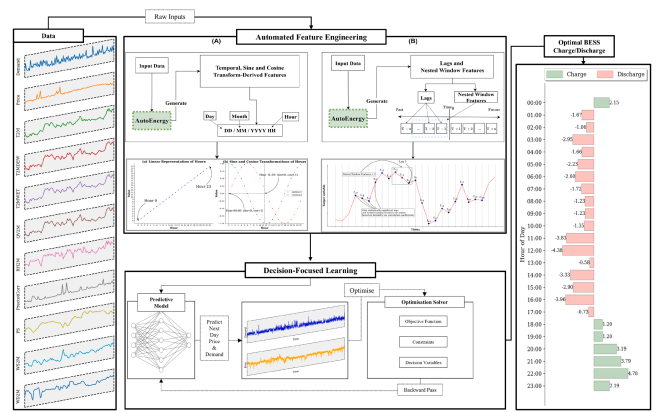
Resumen – Decision-making under uncertainty in energy management is complicated by unknown parameters hindering optimal strategies, particularly in Battery Energy Storage System (BESS) operations. Predict-Then-Optimise (PTO) approaches treat forecasting and optimisation as separate processes, allowing prediction errors to cascade into suboptimal decisions as models minimise forecasting errors rather than optimising downstream tasks. The emerging Decision-Focused Learning (DFL) methods overcome this limitation by integrating prediction and optimisation; however, they are relatively new and have been tested primarily on synthetic datasets with limited evidence of their practical viability. Real-world BESS applications present additional challenges, including greater variability and data scarcity due to collection constraints. Because of these challenges, this work leverages Automated Feature Engineering (AFE) to improve the nascent approach of DFL. This AFE–DFL integration automatically extracts decision-relevant features from limited energy data without requiring domain expertise, while ensuring features directly enhance BESS operational decisions rather than merely improving prediction accuracy metrics. We propose an AFE–DFL framework suitable for small datasets that forecasts electricity prices and demand while optimising BESS operations to minimise costs. We validate the framework’s effectiveness on a novel real-world UK property dataset. The evaluation compares DFL methods against PTO, with and without AFE. Results show that DFL yields lower operating costs than PTO, and adding AFE further improves DFL performance by 22.9–56.5 % compared to models without AFE. These findings provide empirical evidence for DFL’s practical viability, demonstrating that AFE-DFL integration reduces reliance on domain expertise while achieving superior economic outcomes for BESS optimisation.
Publicado en – Expert Systems with Applications, Volume 302, 15 March 2026, 130554